
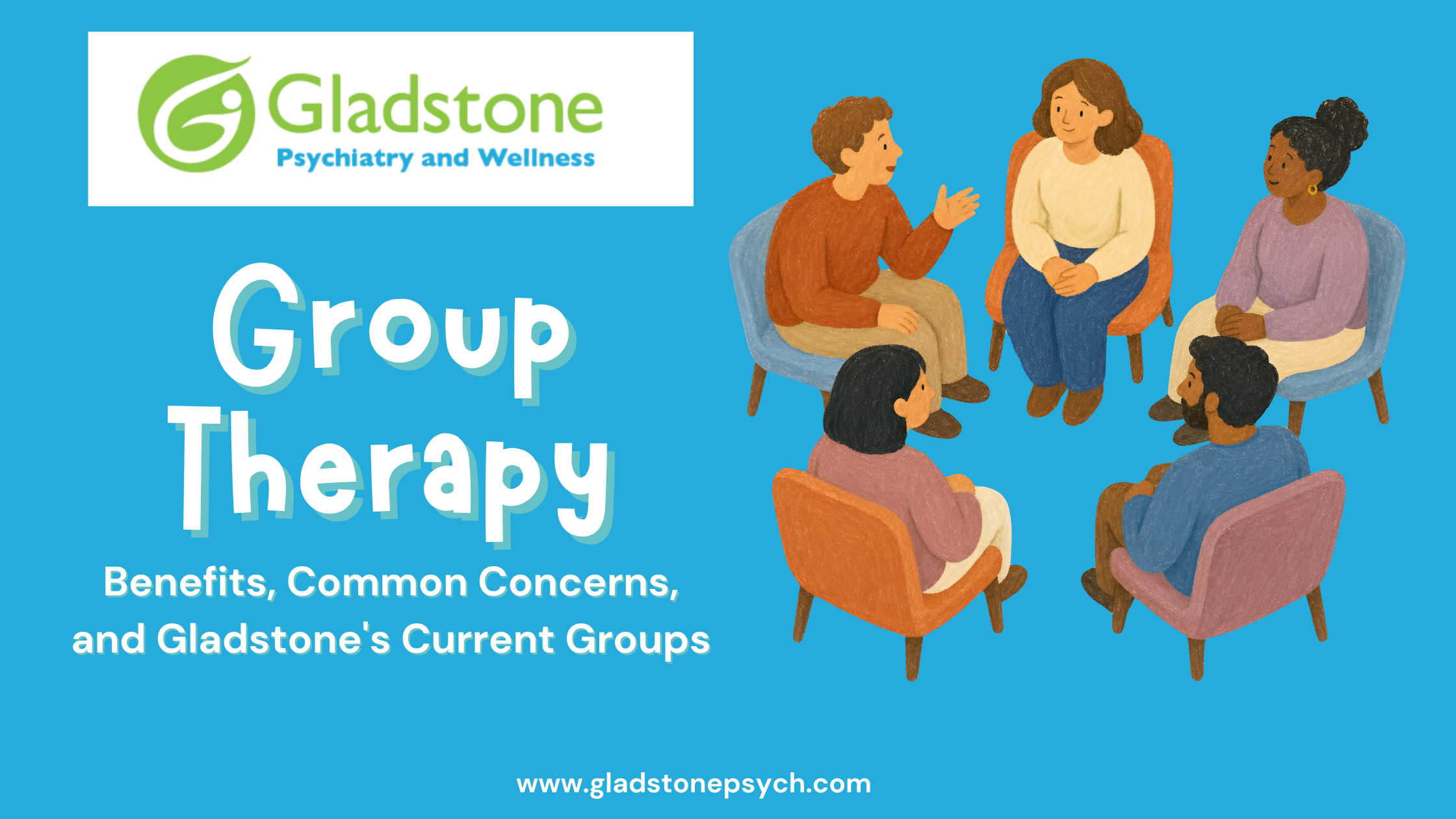
Is Group Therapy Right for You? Benefits, Common Concerns, and Gladstone’s Current Groups
If your therapist has suggested group therapy and your first reaction was “No, thank you,” you’re in good company. Many people have difficulty imagining how group therapy will benefit them. They picture sitting in a circle of strangers, being put on the spot, or hearing opinions they never asked for. Those worries make sense, and they deserve a real answer.
Here’s the good news: group therapy is one of the most well-researched forms of mental health treatment, and for many concerns it works as well as individual therapy. It also offers something individual sessions can’t: the experience of being understood by people who know what you’re going through, firsthand.
Below, we’ll walk through what group therapy actually looks like, why it helps, and how we handle the concerns we hear most often from our clients at Gladstone Psychiatry and Wellness.
What Actually Happens in Group Therapy?
Group therapy is a structured session led by a licensed therapist, usually with a small group of people working on similar concerns. It is not a free-for-all, and it is not a room full of people waiting to critique you.
“One of the biggest benefits of group therapy is it creates a supportive space where participants can normalize their struggles,” says Greg Franklin, LCPC, Gladstone’s Associate Director of Therapeutic Services. “This helps to reduce feelings of isolation, provides multiple and diverse perspectives with practical feedback from peers facing similar challenges. The presence of a skilled clinician facilitating the group maintains safety while teaching coping strategies and developing skills in a safe, learning environment.”
A typical group session might include:
- A brief check-in: where each person shares as much or as little as they choose
- A focused topic or skill: such as managing stress, communicating during conflict, or setting boundaries
- Guided discussion: where members reflect on how the topic shows up in their own lives
- Practice and takeaways you can use during the week
The therapist’s role is to keep the group safe, focused, and respectful. That includes setting group agreements at the start, such as confidentiality, speaking from your own experience, and giving everyone a chance to be heard. Many of Gladstone’s groups meet virtually, so you can join from the comfort of home.
The Benefits of Group Therapy
You realize you’re not the only one. Struggles like anxiety, conflict at home, or burnout can feel isolating. Hearing someone else describe the exact thing you’ve been feeling is often a turning point. Therapists call this universality, and it’s one of the most powerful parts of group work.
You learn from people who’ve been there. Other members may be a few steps ahead of you or a few steps behind. Hearing what has worked for someone in a similar situation can make change feel more possible.
You get to help others, too. Offering support to another member builds confidence and reminds you that your experiences have value.
You practice real-life skills in real time. Group is a safe place to try out new ways of communicating, like expressing a need, saying no, or responding calmly when you disagree. Then you can take those skills into your relationships, your workplace, and your family.
You gain perspective. Other members may notice patterns or strengths that are hard to see from the inside.
It’s often more accessible. Group therapy is typically covered by insurance and can be a cost-effective way to get consistent, weekly support, either on its own or alongside individual therapy.
Common Concerns About Group Therapy (and What Actually Happens)
“I’m worried I’ll be judged.”
This is the concern we hear most, and it’s completely understandable. Opening up in front of people you don’t know feels vulnerable.
In practice, most people find that the group is far more accepting than they expected. Everyone in the room has joined because they’re working through something, too. Nobody is there to evaluate you.
Your therapist also helps create that safety. Groups begin with clear agreements about confidentiality and respectful communication. And you are always in charge of how much you share. Many members spend their first session or two mostly listening, and that is perfectly okay.
“I don’t want people telling me what to do.”
You might be worried that sharing a problem will invite a flood of opinions about how you “should” handle it. A well-run therapy group is not an advice column.
Group leaders actively guide members away from unsolicited advice. Instead, members are encouraged to speak from their own experience, such as “When I was in a similar spot, what helped me was…” rather than “You need to…” This keeps the focus on understanding, not fixing.
You can also let the group know what you need. Saying “I’m not looking for suggestions right now, I just needed to get this out” is welcome in Group. In fact, it’s great practice in asking for what you need. And when someone does share an idea, you’re free to take what’s useful and leave the rest.
“What if someone in the group gets on my nerves?”
Sometimes clients tell us they’ve felt triggered in a group by another member who seemed annoying or rude. Maybe someone interrupted, talked a lot, or came across as abrupt. Those reactions are real, and you don’t have to pretend they aren’t happening.
Here’s what we want you to know:
- Managing the group is the therapist’s job, not yours. If someone dominates the conversation, interrupts, or speaks in a way that feels hurtful, the facilitator will step in and redirect. Group agreements apply to everyone.
- You can speak up privately. If something in Group bothers you, tell your group leader or your individual therapist. That feedback helps us keep the group working for everyone.
- Your reaction can be useful information. The people who frustrate us in Group often remind us of people who frustrate us outside of it, like a coworker, an ex, or a family member. Group gives you a supported space to notice that reaction and practice responding in a way that fits your goals.
- Different communication styles aren’t always what they seem. A member who seems blunt may be anxious, new to the group, or still learning skills of their own. Over time, many clients find that the person they struggled with at first becomes someone they understand and even root for.
In other words, a challenging moment in Group is not a sign that Group isn’t working. Handled with support, it can be one of the most meaningful parts of the process.
“I’m not comfortable talking in front of people.”
You don’t have to be a natural talker to benefit from the group. Listening is participation, too. Most members find that their comfort grows naturally over a few sessions. Virtual groups can also feel less intimidating than sitting in a room together, since you can join from a familiar space.
Therapy Groups Currently Available at Gladstone
Each of our groups is led by a licensed therapist and focuses on a specific set of challenges, so you’ll be surrounded by people who truly get it.
Group Therapy for Stress & Anxiety: From Overwhelmed to Empowered
Stress and anxiety can feel isolating, but healing doesn’t have to be a solo journey. This group offers a welcoming space to talk openly about your challenges and learn mindfulness-based techniques to reduce stress. Through guided exercises and shared support, you’ll build strategies for more balance in your daily life.
When: Mondays, 6:30 to 8:00 PM ET
Parenting with Purpose, Not Perfection
Feeling frustrated, disconnected, or stuck in conflict with your child? This parenting skills group is for parents and guardians navigating disruptive, explosive, or argumentative behaviors. You’ll explore a range of parenting topics, share experiences with other parents, and leave with practical tools to feel more confident and connected.
When: Tuesdays, 6:00 to 7:00 PM ET Where: Virtual via Zoom
Navigating Antagonism: From Conflict to Clarity
This virtual support group is designed specifically for women facing ongoing conflict in relationships, divorce, or co-parenting. Through guided sessions, expert guidance, and shared experiences, you’ll gain tools to manage difficult dynamics, set boundaries, and reclaim your peace of mind.
Where: Virtual
Insurance: Most of our groups are covered by major insurance plans, including Aetna, CareFirst/BCBS, Cigna, and United. Self-pay options are also available.
Ready to Take the First Step and See How Group Therapy Can Benefit You?
Feeling nervous about joining a group is normal, and it doesn’t mean Group isn’t right for you. If you have questions about what a group is like, or which one might be the best fit, we’re happy to talk it through with you. You can also bring your questions to your individual therapist.
To learn more or reserve your spot, contact our team:
- Email: [email protected]
- Call: (443) 708-5856
- Online: New Patients No Need to Call Form
You don’t have to navigate stress, conflict, or parenting challenges on your own. Sometimes the most healing thing is discovering that others understand.
Clinical Review and Approval: This content has been reviewed and approved by the clinical team at Gladstone Psychiatry and Wellness.

